

Why the Future of Oncology Depends on More Than Medicine
By David Hutchful
When most people think about advances in cancer care, they think about new drugs, new therapies, or breakthrough discoveries in biology. But increasingly, one of the most important determinants of progress in oncology is something far less visible: data infrastructure.
Modern cancer care generates enormous amounts of information. Pathology reports, imaging, genomic sequencing data, treatment histories, laboratory results, adverse events, survival outcomes, and physician notes all contribute to a patient’s cancer story. Yet in many healthcare systems around the world, this information remains fragmented across disconnected systems.
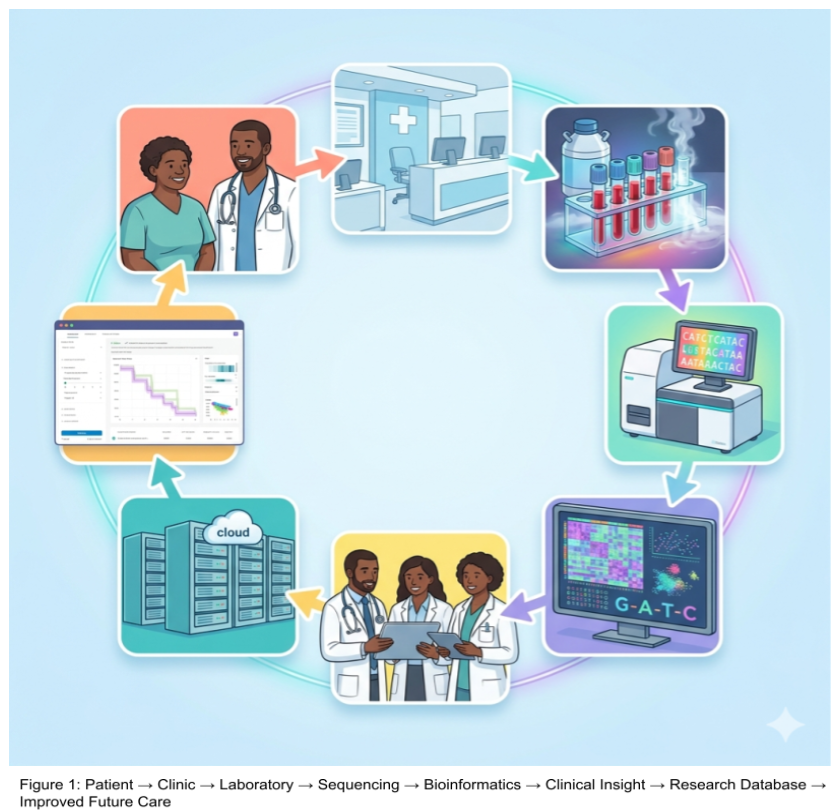
Photo Credit: Gemini AI/Google
A patient may receive imaging in one facility, surgery in another, chemotherapy in a third, and genomic testing elsewhere entirely. The result is that clinicians often have only partial visibility into the patient journey, while researchers struggle to assemble high-quality datasets capable of generating meaningful scientific insight.
This fragmentation is not simply an operational inconvenience. It directly affects the future of precision oncology.
At Yemaachi, we think about cancer not only as a biological challenge, but also as a data and systems challenge. In many ways, modern oncology increasingly resembles other data-intensive industries where infrastructure determines what becomes possible.
Just as financial systems depend on trusted digital infrastructure to move money reliably, precision medicine depends on trusted biomedical infrastructure to move information reliably.
The quality of that infrastructure matters enormously.
A genomic sequence without clinical context has limited value. A pathology result without longitudinal follow-up limits research usefulness. Even small inconsistencies in how patient information is recorded can reduce the reliability of downstream analyses.
This is why oncology increasingly depends on structured, interoperable, and longitudinal data systems.
Structured data means information is captured consistently. Interoperable data means systems can communicate with one another. Longitudinal data means researchers and clinicians can understand how disease evolves over time.
Together, these capabilities create the foundation for several important advances:
- More accurate biomarker discovery
- Better patient stratification
- Improved treatment selection
- Faster clinical trial recruitment
- Better understanding of treatment response across populations
- More effective development of future therapies
One important misconception is that data infrastructure is primarily a technical concern. In reality, it is deeply clinical.
Every physician note, pathology annotation, biospecimen label, staging update, and treatment outcome contributes to the integrity of the broader system.
The future usefulness of cancer datasets often depends on decisions made during routine clinical care.
For example, incomplete staging information may later limit researchers’ ability to correlate genomic findings with disease progression. Missing treatment timing data may reduce the quality of survival analyses. Inconsistent terminology may complicate machine learning workflows designed to identify patterns across thousands of patients.
Small documentation decisions can have long scientific consequences.
This becomes even more important in the era of artificial intelligence (AI).
AI systems are often discussed as though they are independent technologies. In reality, AI systems inherit the strengths and weaknesses of the data used to train them.
If datasets are fragmented, biased, incomplete, or poorly standardized, AI models will reflect those limitations.
Conversely, high-quality clinical and molecular datasets create the conditions for more reliable and clinically useful AI tools.
This is one reason why globally diverse cancer datasets are becoming increasingly important.
Historically, many genomic reference databases have disproportionately represented patients from a limited number of populations. As precision medicine advances, there is growing recognition that broader population representation improves the scientific robustness of cancer research for everyone.
The goal is not diversity for its own sake. The goal is scientific completeness.
At Yemaachi, we believe building high-quality biomedical infrastructure is foundational to innovations in oncology. The future of cancer research will not depend solely on discovering new molecules. It will also depend on building systems capable of learning continuously from every patient interaction.
This is what learning health systems aspire to achieve: clinical care and research improving one another in a continuous feedback loop.
In this future, every patient encounter contributes, securely and ethically, to improving future care.
And behind that future lies infrastructure.
Not only biological infrastructure.
But digital infrastructure, computational infrastructure, and data infrastructure operating together.
The future of oncology will belong not only to institutions that generate data, but to those capable of organizing, interpreting, and learning from it responsibly.©